
Hemophilia is a rare inherited bleeding disorder caused by a deficiency of certain clotting factors. It is X-linked, which largely explains the perception that it was a disease that affected only males.
Because men have only one X chromosome, they develop the disease if that chromosome carries the mutation. Women, on the other hand , who have two X chromosomes, have traditionally been considered “carriers, ” since they may have one affected chromosome and one healthy one that compensates for the loss of function. This interpretation has contributed to the fact that many women may also experience symptoms when, for example, their levels of the factor are low.
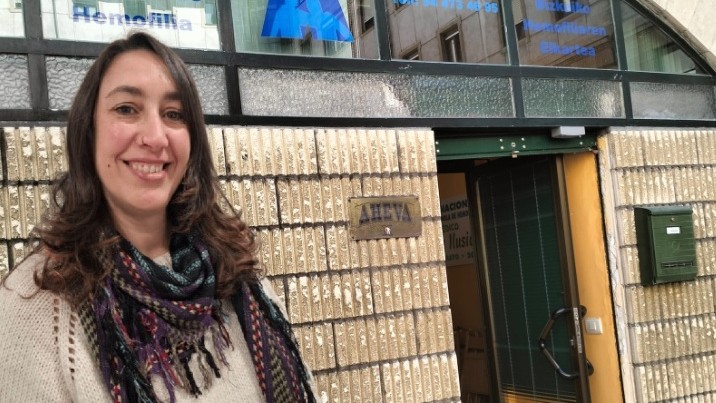
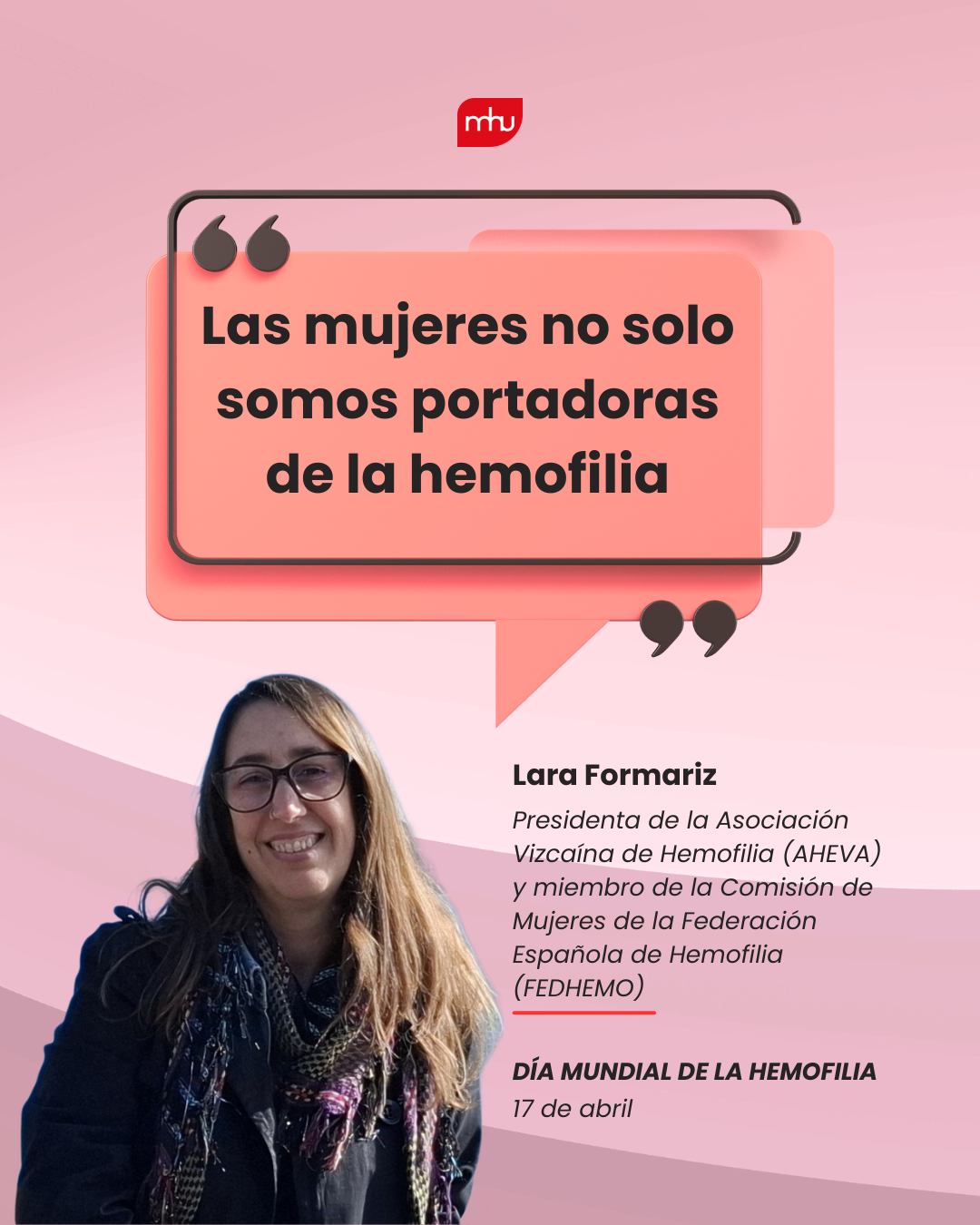
In observance of World Hemophilia Day, celebrated annually on April 17, AELMHU interviewed Lara Formariz, president of the Vizcaya Hemophilia Association (AHEVA), a member of the Spanish Hemophilia Federation (FEDHEMO), and a member of its Women’s Commission, to reflect on historical barriers, current challenges, and the progress made for women living with these conditions.
As she explains, one of the key factors in shaping the belief that this is a condition exclusive to men has been language itself: “The very term used to describe women with hemophilia—‘carriers’—already shapes our thinking.” Historically, this label has implied that women “only carry and only pass on” the disease, but do not suffer from it themselves.
This approach has had far-reaching consequences. As Lara Formariz points out, it has led to a widespread belief that women do not experience hematological problems associated with hemophilia. “It’s something we’ve all inherited—the patients themselves, but also healthcare providers. The result has been a systematic invisibility of women with coagulopathies. Not only in public discourse, but also in daily clinical practice, ” she states.
Symptoms in women
The lack of recognition of hemophilia in women is not merely a conceptual issue: “It has a direct impact on health and quality of life.” The president of AHEVA explains that this invisibility has led to “delays in diagnosis, ” as well as a lack of treatments tailored to their needs, which “in the long term can significantly affect patients’ physical and emotional well-being.”
In her own case, her relationship with coagulopathies is shaped by her family history. As the daughter of a father with hemophilia, she has been considered a “compulsory carrier” her entire life . However, it wasn’t until later that she began to come to terms with her own reality.
“Like many women, I, too, have gradually come to realize what I was dealing with and that certain things that had happened to me throughout my life—which I hadn’t previously linked to that coagulopathy—actually were related to it,” she explains.
For Lara Formariz, one of the major shortcomings in the approach to these conditions in women is a lack of awareness of their specific symptoms. She argues that the historical lack of association between hemophilia and women has led to their symptoms being downplayed: “Since there hasn’t been a clear association, the problems are downplayed, and therefore they cannot be treated.”
For example, she notes that, in gynecological terms, these symptoms are particularly common. Among them, she mentions “prolonged and heavy menstrual bleeding, ” as well as recurrent anemia resulting from this bleeding.
But they are not the only ones: “There is also increased bleeding during surgical or dental procedures, frequent bruising for no apparent reason, and complications during and after childbirth—particularly critical moments in the life of a woman with a bleeding disorder.”
In addition, she points to possible joint problems, an area that has yet to be thoroughly studied in women. “We don’t really know whether the joint pain we experience is related to the coagulopathy or not, because no one has studied it, ” she laments.
For all these reasons, she believes that this “lack of scientific evidence” underscores the need to promote research with a gender perspective—one of the main demands of the group and of the FEDHEMO Women’s Commission, of which she herself is a member.
Emotional impact and impact on daily life
She also points out that the challenges faced by women with coagulopathies begin at an early age. According to the FEDHEMO spokesperson, “in many cases, girls aren’t even given diagnostic tests”, postponing this decision until they reach adulthood, which delays the detection of the disease.
This situation is particularly problematic when one considers that a girl’s first period may be her first major bleeding episode. “They should have been examined before that, ” he insists.
Beyond the physical symptoms, she notes that hemophilia in women has a significant emotional impact. In this regard, she emphasizes that uncertainty is one of the most difficult factors to manage: “I think the period of uncertainty is always worse than receiving a diagnosis. Not knowing what is happening, being unable to access information or resources, and having no explanation for the symptoms creates a significant psychological burden.”
Added to this is the impact on daily life: “For girls, heavy and prolonged bleeding caused by menstruation can limit their participation in school or social activities. In adulthood, these challenges carry over into the workplace and personal life. It feels like there are things you can’t do because your health condition limits you. All of that has an impact.”
Training and a gender-sensitive approach: keys to progress
To turn this situation around, Lara Formariz stresses the importance of taking action on several fronts. The first is early diagnosis. “It’s extremely important that we get diagnosed in the first place, and that it happens as soon as possible,” she emphasizes.
But she points out that diagnosis alone is not enough. She also considers it essential to “improve training for healthcare professionals and raise awareness of women’s specific needs.”
In this regard, he advocates for improvedcoordination among specialties such as Hematology, Gynecology, and Primary Care to provide comprehensive care to affected women. In this context, he cites as an example the difficulties many women face when they visit a doctor’s office.
Lara Formariz describes situations in which patients themselves have to explain their condition to specialists: “Sometimes they tell us right off the bat, ‘Well, but you’re just a carrier.’” For her, this lack of initial recognition shapes the entire care process: “If you’re not even seeing me from the start, how are you going to treat me?”
The FEDHEMO Women's Commission: Visibility and Advocacy
In light of this reality, the nonprofit sector has played a vital role. The creation of the FEDHEMO Women’s Commission was established precisely to address these issues and bring them to the forefront. Its origins can be traced back to a process of collective awareness. Following an earlier attempt, it was during a gathering of women that the initiative took shape.
The goal was clear: to create a space of our own where we could share experiences, identify needs, and articulate our demands. “We needed a space where we could all talk and reflect together, ” explains Lara Formariz.
Since then,the Commission has pursued various lines of work, including raising public awareness, promoting early diagnosis, educating patients and healthcare professionals, and creating support networks. In addition, the annual women’s gatherings have become a hallmark of the Federation, complemented by ongoing communication channels among associations that strengthen support and facilitate the sharing of identified needs and actions taken with this group.