

A single number on a lab report can change a person’s daily routine. In the case of primary immune thrombocytopenia (PTI), a low platelet count can become a source of uncertainty and concern, especially given the risk of bleeding. But the disease goes far beyond that single number.
ITP is an autoimmune hematologic disorder in which the immune system attacks the body’s own platelets and may also impair their production. As a result, platelet counts may drop, increasing the risk of bleeding. Frequent bruising, nosebleeds, bleeding gums, and heavy menstrual bleeding may be some of its symptoms, although the course of the disease varies from patient to patient.
A disease that affects daily life
Can I exercise? Can I travel? Can I have dental work done? Do I need to change my routines? These are some of the questions that may arise after a diagnosis, especially when platelet counts are very low. “Patients feel a great deal of anxiety about finding out their platelet count. ‘What’s my platelet count today?’” explains Javier Letellez, a hospital pharmacy specialist at Fuenlabrada Hospital (Madrid); but this uncertainty can end up affecting a large part of daily life. “Can I go skiing? Can I do this activity? Just when I was feeling fine, I had a blood test and it turns out my platelet count is low,” Letellez explains.
Restrictions depend on each person’s clinical condition, but they may particularly affect activities that involve a risk of injury or trauma. In addition, doctor’s appointments, lab tests, and treatments may require changes to one’s routine and, in some cases, impact work and family life.
In addition to this physical impact, there is another, less visible one. “What patients mention most is that they feel fatigued and experience emotional problems,” Letellez notes. Anxiety, changes in daily life, and physical and mental exhaustion can thus become a significant part of the experience of those living with PTI.
From the patients' perspective, Miguel Ángel Martín, secretary general of the Spanish Hemophilia Federation (FEDHEMO), emphasizes that the disease cannot be assessed solely through laboratory tests and platelet counts; rather, it involves a much wider range of symptoms.
From Diagnosis to Personalized Care
Diagnosis is not always straightforward. Low platelet counts can have various causes, and a medical evaluation is necessary to diagnose ITP and rule out other conditions.
Once diagnosed, the hematologist becomes the patient’s primary point of contact, especially in situations that may increase the risk of bleeding. Surgical procedures—or even certain dental procedures—require a prior assessment of platelet levels and the implementation of necessary measures.
For Martín, having professionals with specific experience in PTI is essential.
“It’s often the case that autonomous communities lack a protocol for managing rare hematological diseases, and patients end up being referred to a healthcare professional who has never seen a patient with ITP in their life,” notes Miguel Ángel Martín.
For this reason, patient advocacy groups are calling for more coordinated and specialized care. “It would be highly advisable to establish referral centers by province or by health region staffed by experienced hematologists dedicated to this field,” he notes, “so that patients can access high-quality, equitable, and coordinated health care throughout the country.”
Personalization is also one of the keys to treatment. “It has to be comprehensive and personalized because we’re seeing more and more that each patient tolerates a different set of treatments and should be treated on an individual basis,” adds Martín.
New Treatment Options
The treatment of ITP has evolved significantly in recent years. For a long time, corticosteroids have been one of the main tools for managing the disease, while other therapeutic strategies, such as splenectomy, have also played a role in certain patients.
There are currently various options and mechanisms of action. Some strategies aim to reduce the destruction of platelets by the immune system, while others aim to promote their production.
“Recently, in the last few years, we have been fortunate to have new treatment options with different mechanisms of action,” explains Letellez.
This change has made it possible to expand treatment options for patients who do not respond adequately to previous treatments or for whom certain strategies are not appropriate.
Furthermore, research continues to advance. “There are molecules in development and new ones being studied. All we need is for them to become part of our daily practice soon so that we can choose the one that best suits our patients at every stage of the disease,” he notes.
For Martín, this breakthrough has marked a significant shift in how the disease is treated: “I think science is now moving forward little by little, but with very solid steps in the fight against this disease.”
There are still questions that need to be answered
Despite advances in treatment, PTI continues to pose significant challenges. One of them is gaining a better understanding of its origin.
“Among the unmet needs, what we lack most is much more basic research, mainly because we don’t yet understand the etiology of the disease,” explains Letellez.
It also considers it necessary to make progress in identifying biomarkers that can predict the course of the disease and better guide treatment decisions.
Although effective treatments exist, not all patients respond in the same way or maintain their response for the same length of time. The challenge, therefore, lies not only in having more treatment options available, but also in being able to identify which one is most appropriate for each individual at every stage of the disease.
Added to this is the need for healthcare professionals to better understand the overall impact of ITP. “Raising awareness among all healthcare professionals about the disease” is, for Letellez, another unmet need. “It’s not just about understanding that the patient has low platelet counts, but also the emotional and social burden that can accompany the disease,” he notes.
The Patient's Voice, Including in Research
Clinical research is another area in which patient involvement can be particularly important.
“Clinical trials do not reflect the general patient population,” Letellez points out. Some populations may be underrepresented, which is why patient registries play a crucial role in generating evidence about how the disease behaves in situations that are not always captured in clinical trials.
“It’s a rare disease, but not that rare, which allows us to have a significant number of patients across all centers—enough to gather more information and learn how to best treat them,” he notes.
Information and Support for Living with PTI
These associations also help convey the needs of people with PTI to researchers and companies. FEDHEMO is an organization that works in the field of blood disorders and aims to improve the quality of life for those affected and their families. Thus, as Martín explains, FEDHEMO focuses on raising awareness, advocating for patients’ rights, providing information on clinical trials, and facilitating contact with specialized professionals.
“The patient’s voice must be heard,” says Martín. And that participation should take into account not only the clinical aspects of the disease, but also its emotional and social impact.
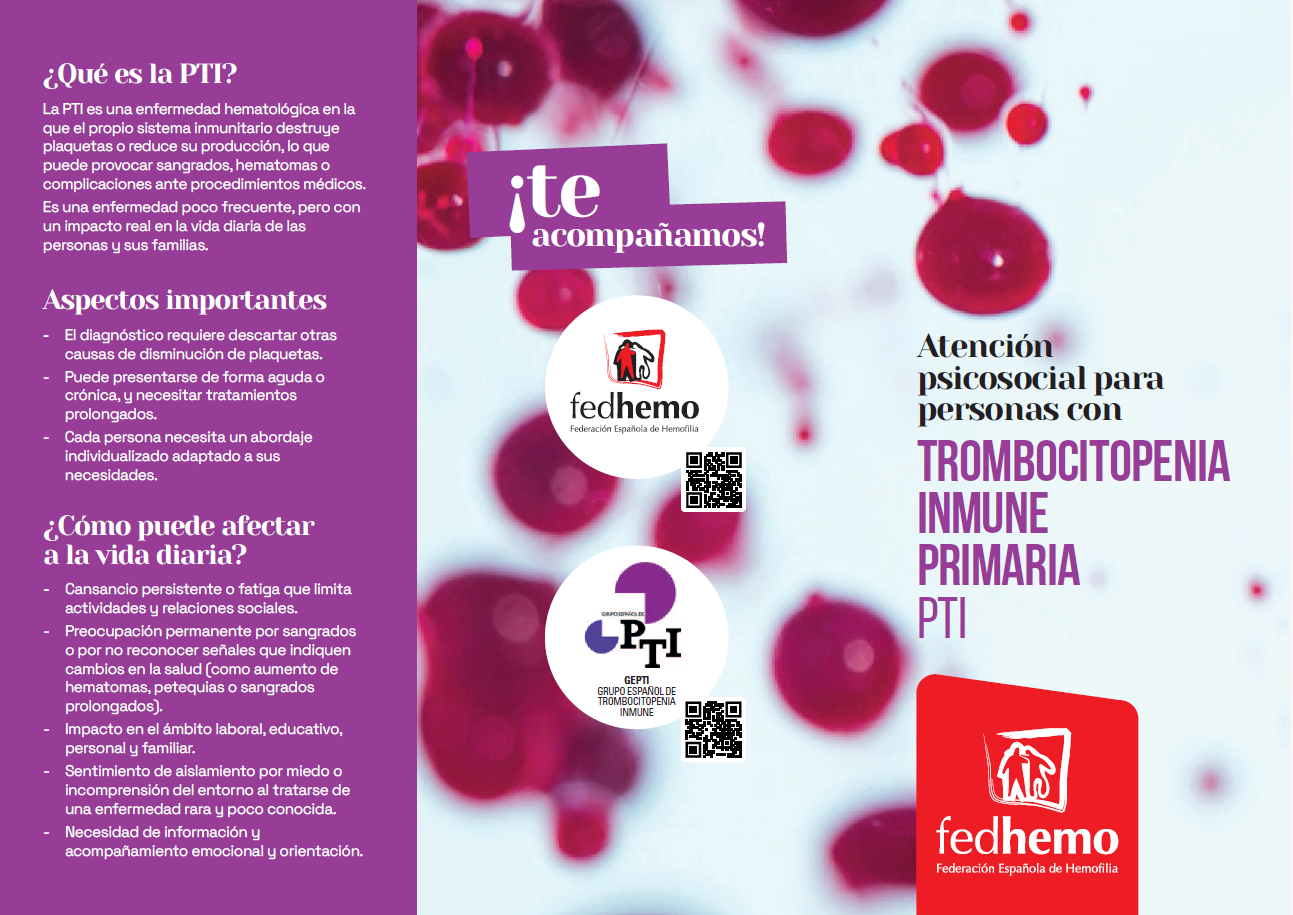
Support becomes especially important after a diagnosis. For someone who has just received the news, finding reliable information and connecting with other patients can help them cope with the questions that arise in the immediate aftermath.
Martín highlights the role of mutual-aid groups and patient organizations as spaces for sharing experiences and addressing questions.
“When you’re diagnosed with an illness, meeting people who are facing the same challenges as you is very rewarding,” explains the secretary general of FEDHEMO.
These spaces offer insights into how other people have coped with their diagnosis, treatments, or changes in their daily lives.
But the hospital pharmacist’s supportive role is also important. Letellez points out that “we help them commit to their treatment, promote adherence, and prevent problems with other medications… the goal is to make patients’ lives easier.”
Because, although the progression of PTI and its impact vary from person to person, there is one common reality: the disease cannot be understood solely based on the number that appears in a blood test.
Advances in research and treatment have expanded the options available to patients, but there are still challenges to address: gaining a better understanding of the disease’s origin, identifying which treatment works best for each individual, generating more evidence in underrepresented populations, and providing truly comprehensive care.
Meanwhile, the combination of therapeutic innovation, clinical experience, research, and patient involvement will continue to be key to advancing the management of primary immune thrombocytopenia.