
AELMHU, together with AESEG,anefp, AseBio, BioSim,Farmaindustria and STANPA, national representatives of the human pharmaceuticals and cosmetics sectors, have presented a report prepared in collaboration with PwC on the impact and new regulatory, economic, and operational challenges arising from Directive (EU) 2024/3019 of the European Parliament and of the Council of November 27, 2024, on the treatment of urban wastewater, at a time of growing European debate regarding the implementation of the Extended Producer Responsibility (EPR) system provided for in the regulation.
We, the associations, share the environmental objectives of the Directive, but we call for a prudent and legally sound transposition, based on principles of proportionality and sound scientific evidence.
The report, the result of more than a year of work by the seven associations in coordination with PwC, analyzes the implications of the Directive, which raises the standards for urban wastewater treatment and introduces a new EPR system for human medicines and cosmetic products.
Regulatory, technical, and economic uncertainties
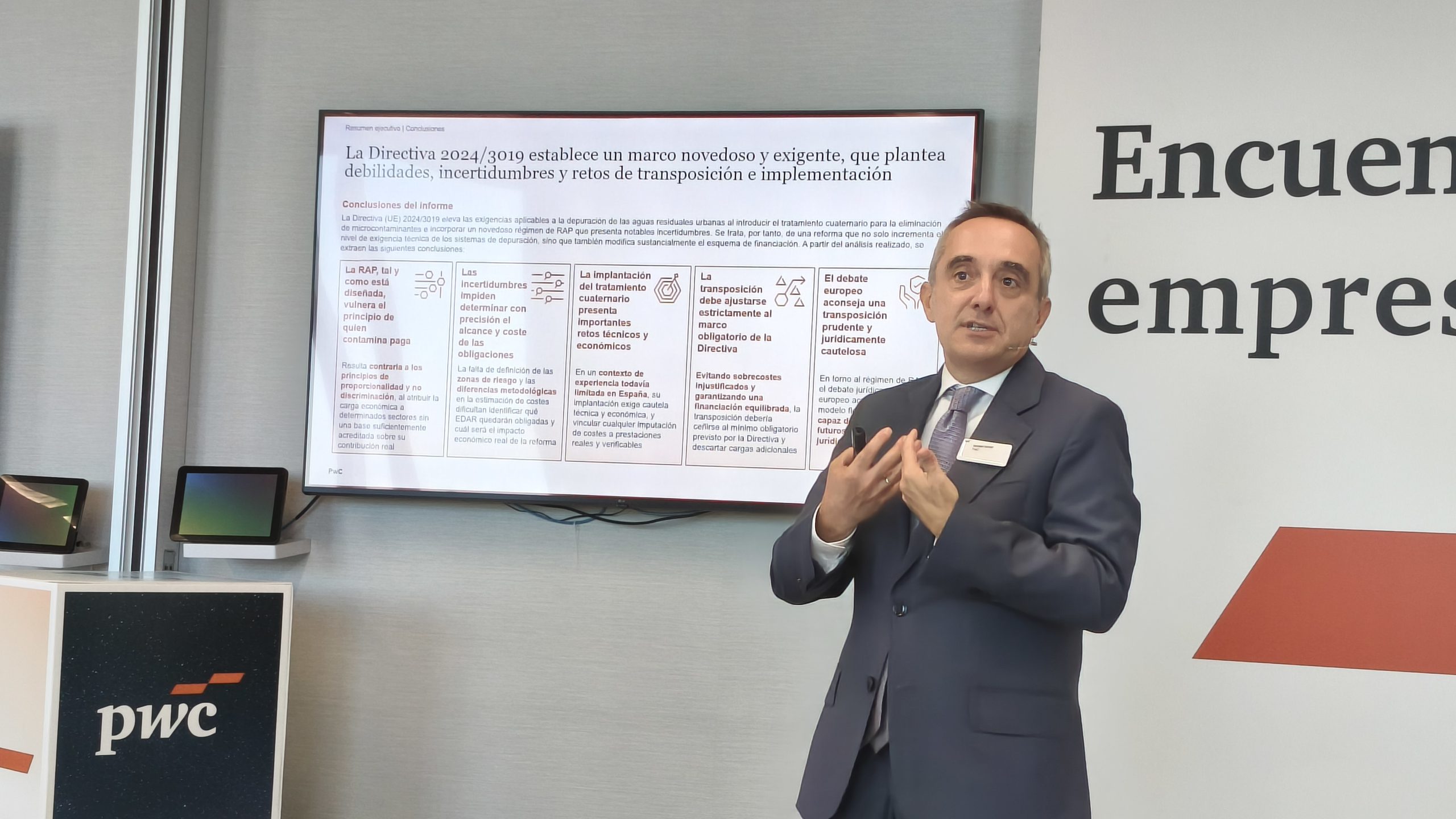
The analysis identifies significant uncertainties regarding the design and implementation of the RAP, which, the report concludes, make it impossible to accurately determine how the exemption criteria are applied, as well as the actual scope of the obligations and their costs. These uncertainties include the identification of the substances to be considered, the criteria for assessing their hazard levels, the conditions for exemptions, and the delineation of risk zones.
The application of these criteria will be particularly important in determining which products are subject to the new regime. The Directive provides for exemptions for products containing substances that are rapidly biodegradable, that do not generate micropollutants in wastewater at the end of their useful life, or based on the quantities placed on the market; however, it does not specify in detail how these criteria should be applied. Furthermore, the Directive stipulates that Member States must take into account the need to ensure the availability, accessibility, and affordability of medicines, without specifying how this principle should be implemented under the new regime.
Furthermore, the report considers that the exclusive attribution of RAP to human pharmaceuticals and cosmetic products is based on a methodology with significant uncertainties, including the lack of fully reliable data on the relative contribution of each sector to microcontamination and the use of modeling rather than empirical data in certain analyses. The report thus concludes that the implementation of tertiary treatment poses significant technical and economic challenges, especially given Spain’s still limited experience in this area, and highlights the need for the transposition to provide clarity and legal certainty and to precisely define the obligations and eligible costs.
We, the associations , believe that the RAP system, as currently designed, violates the “polluter pays” principle and runs counter to the principles of proportionality and non-discrimination. Therefore, we believe that Spain’s transposition of the legislation will be crucial to ensuring a proportionate, balanced, and legally sound implementation.
You can view the executive summary here.