
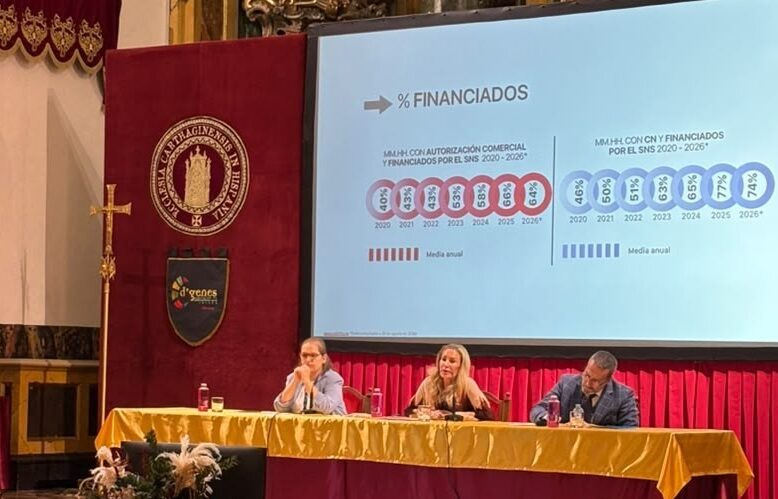
AELMHU participated in the 19th International Congress on Rare Diseases, organized by the D’Genes Association and the Catholic University of Murcia. Under the theme “Walking Together, Building the Future,” the event brought together patients, healthcare professionals, industry representatives, and healthcare administrators to share the latest advances in diagnosis, treatment, and research, as well as to analyze the main challenges that people with rare diseases continue to face.
Beatriz Perales, president of AELMHU, moderated the panel discussion titled “Access to Orphan Drugs and Advanced Therapies,” which featured Fernando Losana, an attorney, and Milena Peraita, head of the Division of Pharmacology and Clinical Evaluation at the Spanish Agency for Medicines and Health Products (AEMPS).
During her remarks, Beatriz Perales emphasized the importance of ensuring that research and therapeutic innovation reach people with rare diseases in an equitable, efficient, and sustainable manner.
In this regard, he noted that “there are patients waiting, dedicated healthcare professionals, and a system that must be capable of responding to complex and, in many cases, urgent needs.”
The president of AELMHU also shared key data from the latest “Report on Access to Orphan Drugs in Spain,” updated as of August 31, 2026. According to the document, of the 164 orphan drugs with marketing authorization in Europe, 141 have a national code in Spain and 105 are covered by the National Health System (SNS), representing 64% of the total. However, it has drawn attention to the funding conditions: 62% of the funded drugs are subject to some type of restriction, either due to limitations on authorized indications or because funding is not available for some of them.
With regard to advanced therapies, as of August 31, 18 have marketing authorization in Europe, of which 9 are covered by the Spanish National Health System (SNS).
The roundtable also provided an opportunity to address the inequalities that persist in our healthcare system regarding the treatment of rare diseases and the role of regulatory agencies in the development of and access to therapies for rare diseases.
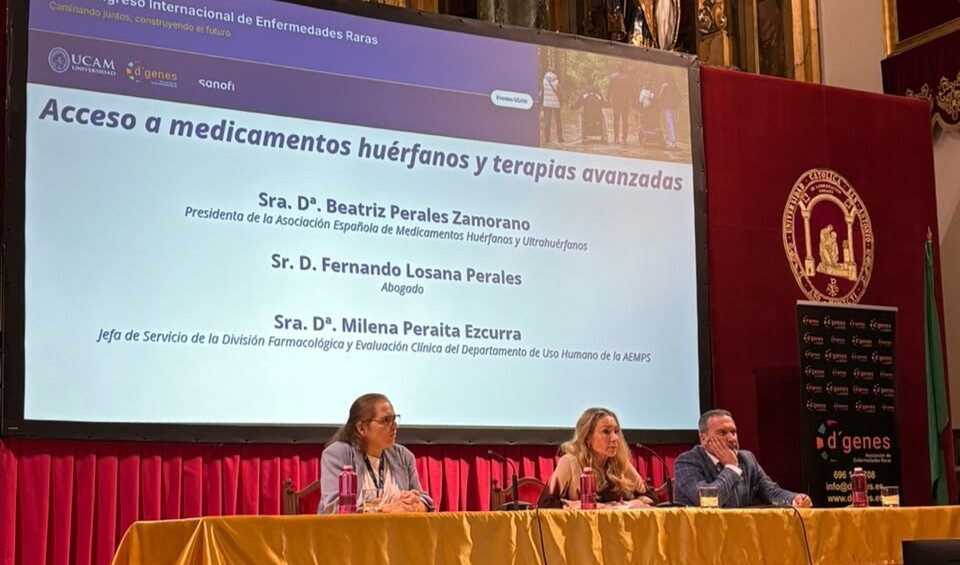
For his part, Fernando Losana analyzed inequalities in access to treatment and argued that receiving a medication should not depend on a family’s ability to go to court. He also emphasized the need to establish clear timelines, provide reasoned decisions, and conduct assessments that take into account the severity of the disease, each person’s individual needs, the lack of therapeutic alternatives, and the long-term benefits of advanced therapies.
Milena Peraita explained how regulatory agencies support research from its earliest stages. Among other aspects, she addressed the challenges of developing treatments for diseases with a small number of patients, as well as the value of scientific advice and the involvement of regulatory agencies, always ensuring the quality, safety, and efficacy of medications.
The panel concluded with a video testimonial from Jesús Navarro, president of the Mexican Organization for Rare Diseases and father of a girl with mucopolysaccharidosis type I, Hurler variant. His remarks gave attendees insight into the families’ perspective and served as a reminder that, behind these discussions, there are people waiting for answers to their needs.