8/05/2025
On the occasion of World Thalassemia Day, an event that is commemorated every May 8, we talked to Secundino Sacristán, president of ALHETA (Spanish Association for the Fight against Hemoglobinopathies and Thalassemias) and patient of this disease to tell us what this rare disease means and how he has been living with it for 60 years.
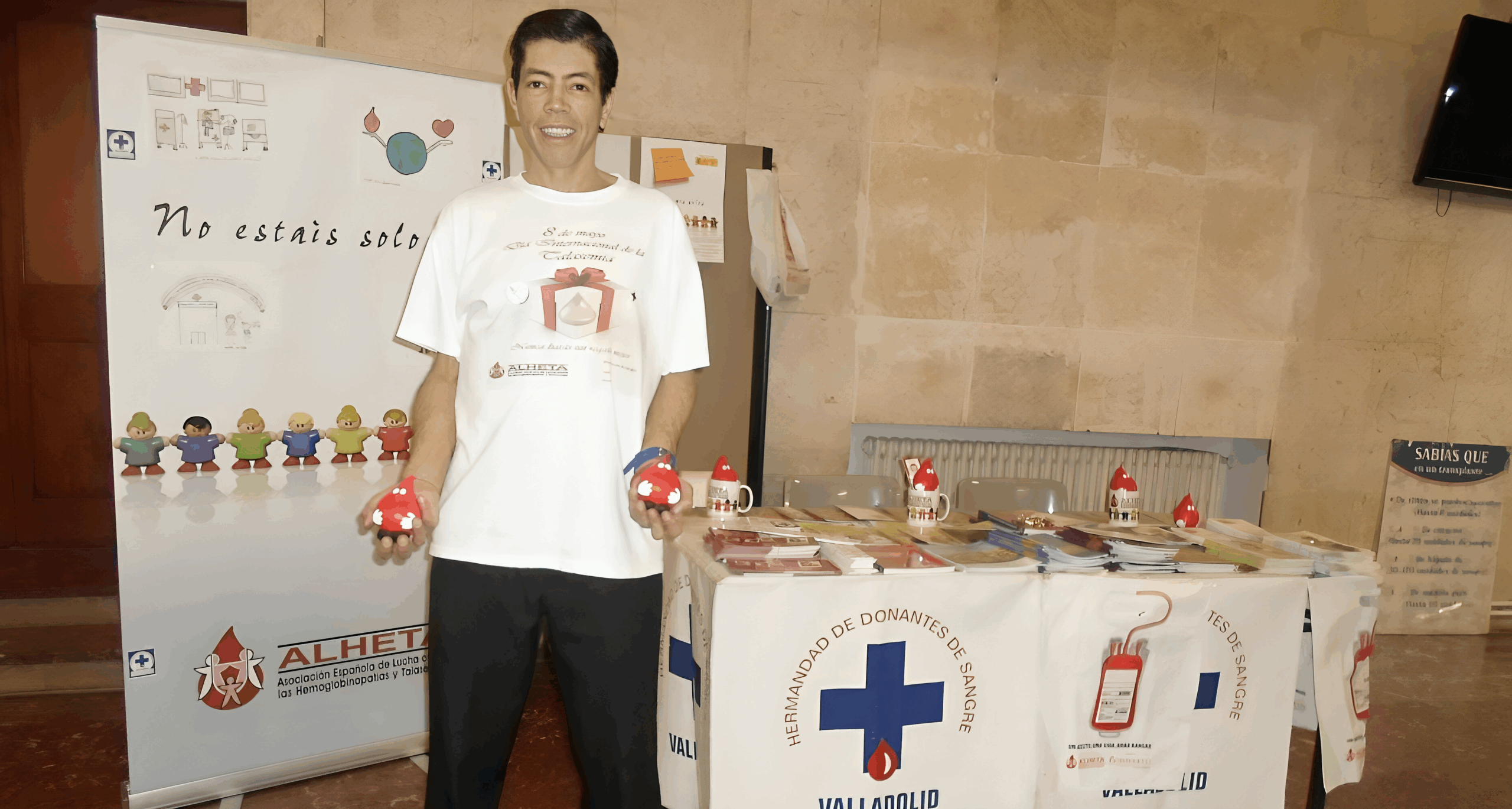
Every two or three weeks, and since he was 6 years old, Secundino walks the corridors of the Hospital Clínico de Valladolid to receive a blood transfusion. According to him, throughout his life, "he may have received more than 1,300 bags".
But the blood that saves him also complicates his existence. Periodic transfusions leave an invisible and persistent residue: Iron that accumulates in his body, because his body can't eliminate it on its own. "The normal thing is to have iron deficiency anemia, but we have anemia with a lot of iron. We make red blood cells, but we make them poorly, and they break down. We release a lot of iron into the blood, and that iron harms us and causes us abysmal anemia."
Secundino lives with thalassemia major, a rare genetic disease that affects the body's ability to functionally produce hemoglobin. According to Orphanet data, its incidence is about 1/10,000.
Hemoglobin is essential for transporting oxygen in the blood. Without it, every cell in the body operates at half speed. "It's like running out of gas in the car," Secundino sums up. "You do things, you get tired, you sleep, and you recover. But us... it's as if we don't recover. We're always tired," he says.
Origin and diagnosis
Thalassemia is genetically inherited. It is a recessive disorder, which means that both parents must be carriers of the mutated gene for their child to develop the most severe form of the disease. However, carriers—also known as “minor thalassemics”—have no symptoms, which complicates early diagnosis because people are often unaware that they have the condition.
Secundino was born in a small town in Valladolid in the 1960s, at a time when thalassemia was practically unknown in Spain. His childhood was marked by extreme tiredness, a worrying yellowness and a height well below the average of his friends. "I was the shortest child in town, I didn't move like the others. My parents took me to many doctors, but they couldn't find the cause". It wasn't until he was six years old that he was diagnosed at the Fundación Jiménez Díaz in Madrid, thanks to his parents' efforts to learn about their son's condition. "I was diagnosed when I was six years old, and by then I was already very ill. They told me that without transfusions I had a short life expectancy, but they could still give me a few months or a year more to live," he recalls.
"This is not a chromosomal thing, it doesn't affect men or women more. It doesn't matter if you are born a boy or a girl. If both parents are carriers, you can get it. I am the son of two carriers and until I was diagnosed, they never knew they were," Secundino says about his pathology.
That was 60 years ago, but today there are genetic-implantational diagnostic tests (embryo selection) that allow carrier couples to avoid transmission of the disease. But the information still does not reach all corners. "There are people who have three children and do not know they are carriers until the third is born with symptoms. The genetic study should always be done and that is one of the Association's requests," explains Secundino.
Symptomatology
Thalassemia not only affects the blood, but, as a consequence, the entire body suffers the consequences of the disease. One such moment in Secundino's childhood was the removal of his spleen. "For me, at the age of nine, my spleen was removed. It normally weighs 100 grams or less. Mine weighed almost three kilos," he recalls vividly. The organ had grown so much that it looked like anything else, he recalls, "As a little boy, I was short and with a swollen belly, as if I were pregnant."
Over the years, and as the disease has progressed, other complications have appeared. The excess iron damages vital organs. "My heart is damaged, my liver is very damaged, I have no spleen or gall bladder. In addition, in a transfusion I was infected with hepatitis C, when I didn't even know it existed."
However, Secundino acknowledges how much the treatment has helped him throughout his life and how, in more than six decades, the knowledge of this disease (and thus the approach to it) has improved dramatically. From painful injections of chelators he had to take every night to today's oral pills. From late diagnosis to neonatal screening in the first 15 days of life. "Today, if you are born with thalassemia, within 15 days you have a diagnosis. Before it was a matter of years... or dying without knowing what you had because it was not known." Now, fortunately, it is one of the diseases that is screened by means of the heel prick test in a large part of Spain.
Science and hope: the importance of blood donation
Secundino says that a bone marrow transplant can be a definitive cure, provided a compatible donor is found (which has happened in several cases in Spain). It can also be cured with gene editing techniques such as CRISPR, which makes it possible to repair the damaged gene: "It's like a 'cut and paste' of the DNA. The gene that does not work is edited and the body starts to make good red blood cells. Some people have already been cured with this," explains Secundino. However, the treatment approved by the European and American agencies (FDA and EMA) is not yet covered by the Spanish healthcare system.
In the meantime, however, Secundino never forgets that he is alive thanks to the anonymous generosity of those who donate blood. "I am alive thanks to donations. But it's not only us who need them. It is very important that people donate blood," he says.
ALHETA: support, accompaniment and community
Since 2003, the ALHETA association has been a space for accompaniment and mutual support. "There are not many of us. In all of Spain there are about 140 thalassemia patients who are transfusion-dependent," he says.
A large part of the association's daily life takes place in WhatsApp groups. In them, patients share experiences, doubts and advice: from when to take chelators to how to deal with a medical test. "We say things like: 'It's better for me to take it before going to bed than on an empty stomach', and other people reply: 'Me too'."
One of the most delicate moments is when a family receives the diagnosis of their son or daughter. "The first thing is to listen. We don't want them to feel alone. We tell them: 'Don't worry, you're in good hands, you can live with this. He acknowledges that "feeling understood, the moments of anguish diminish".
Today, Secundino is probably the longest-living thalassemia major patient in Spain. "I am, I think, the oldest thalassemia patient in Spain. Before, people did not survive. I made it, and that's why I want others to have more options."
His message, far from resignation, is one of struggle, awareness and hope. "Thalassemia is not visible, but it is there. We need to talk about it more. We need to do more research.