
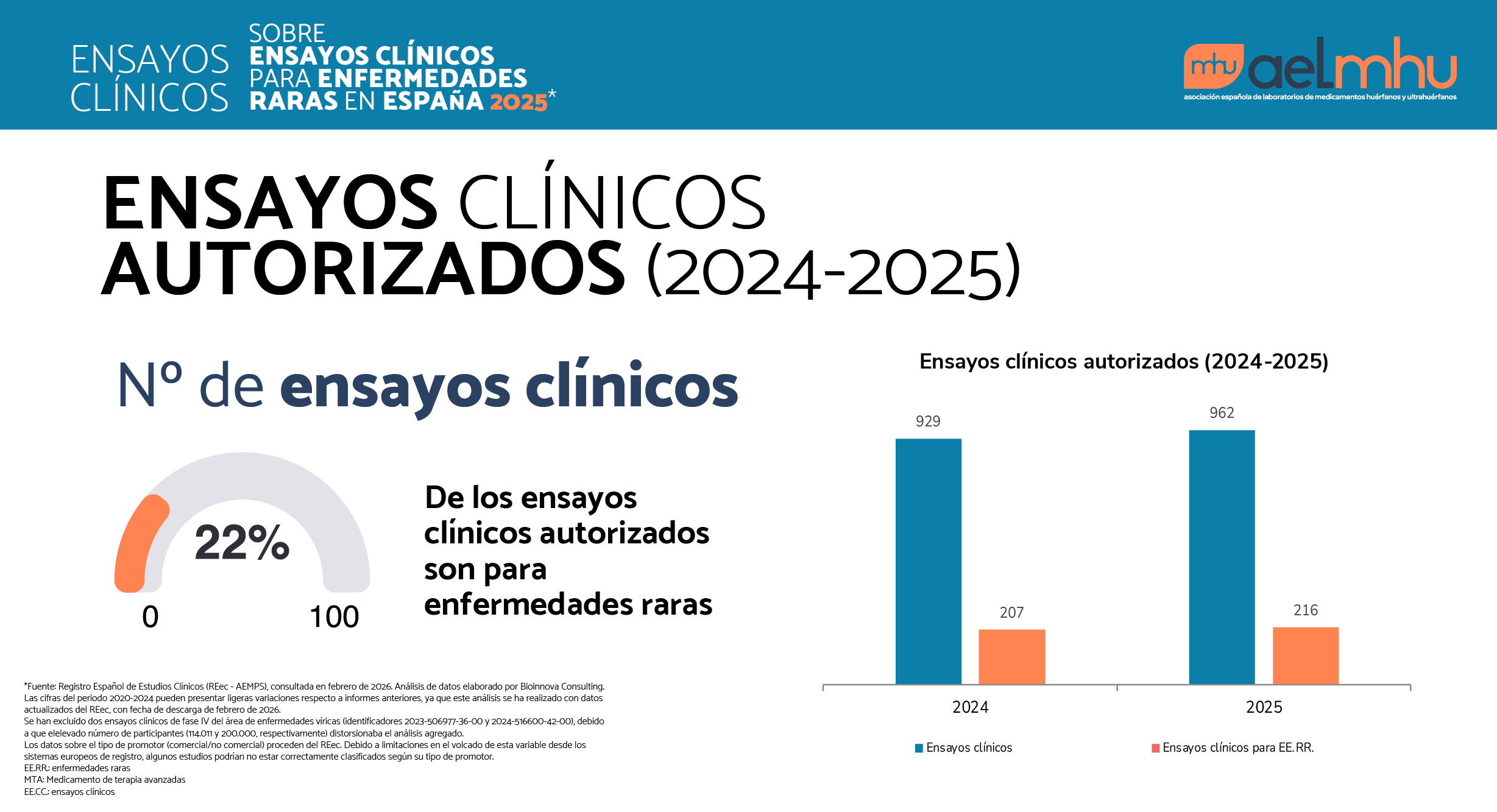
- The number of clinical trials for rare diseases increased by 4% in 2025 compared to the previous year, for a total of 216 studies
- The pharmaceutical industry sponsored 98% of clinical trials for rare diseases
The Spanish Association of Laboratories for Orphan and Ultra-Orphan Drugs (AELMHU) has published the “Report on Clinical Trials for Rare Diseases in Spain 2025, ” which analyzes the most relevant data on clinical trials authorized for these conditions in 2025, as well as their evolution over the past six years in Spain.
According to the report, published to mark International Clinical Trials Day, which is observed this Wednesday, May 20, Catalonia, the Community of Madrid, and Andalusia were the autonomous communities with the highest level of research activity in the field of rare diseases, accounting for more than 50% of studies in 2025.
Specifically, Catalonia participated in 171 trials for rare diseases; followed by the Community of Madrid, with 151; Andalusia, with 100 trials; and the Valencian Community, with 79. However, when adjusting the data for the population of each region, other autonomous communities such as Navarre, Galicia, and the Basque Country also stand out, exceeding the rate of clinical trials per million inhabitants in Catalonia and Andalusia.
Nationwide, according to data from the Spanish Registry of Clinical Trials (REec) of the Spanish Agency for Medicines and Health Products (AEMPS), a total of 962 clinical trials were authorized in Spain in 2025. Of these, 216 focused on rare diseases, representing a 4% increase over the previous year. This means that studies on these conditions account for 22% of the total, a proportion similar to last year’s. Furthermore, there was also an 11% increase in the number of participants in studies for these conditions, reaching 4,088 last year.
Another key finding from the report is that clinical trials for rare diseases sponsored by pharmaceutical companies increased by 8% in 2025, reaching 212 studies, compared with 196 the previous year. Thus, the pharmaceutical industry accounted for 98% of all authorized research on these conditions.
“These figures confirm that research into rare diseases continues to advance and gain a foothold in Spain, which is particularly good news for people with rare diseases who are still waiting for new treatment options. Furthermore, they also demonstrate that the pharmaceutical industry remains firmly committed to innovation in this field. However, we believe that more streamlined administrative processes and greater incentives for R&D are still needed to accelerate the launch of clinical trials and improve Spain’s competitiveness in this field,” said Beatriz Perales, president of AELMHU.
Phases and therapeutic areas of clinical trials for rare diseases
Clinical trials for rare diseases in Spain in 2025 were primarily concentrated in phases II and III, accounting for 72% of the total. Compared to 2024, the 22% increase in phase III trials from the previous year (from 77 to 94 studies) is particularly noteworthy.
With regard to therapeutic areas, the report notes a trend toward greater diversification. Oncology remains the dominant area, with 47 clinical trials for rare diseases in 2025, but its relative share has fallen to 22%, four percentage points lower than in 2024.
Next is the immune system, which has established itself as the second-largest therapeutic area in terms of the number of trials, with a 38% increase: from 32 trials in 2024 to 44 in 2025. Next is the nervous system, with 33 authorized trials, ahead of congenital and hereditary disorders and neonatology, with 27. Also notable is the increase in authorized trials for rare cardiovascular diseases, with 16 clinical trials, doubling the previous year’s figure.
Advanced therapies for rare diseases
The report also details the authorization of clinical trials involving advanced therapy medicinal products. In 2025, the total number of authorized studies fell by 25%, to 40, compared with 53 in 2024. This trend was even more pronounced in the area of rare diseases, where the number of trials dropped from 28 to 10, representing a 64% decline.
Similarly, the number of participants in this type of research also declined, with a total of 870 people enrolled in advanced therapy trials, 138 of whom were patients with rare diseases. Despite the decline compared to the previous year, research into advanced therapies remains key to facilitating access to innovative treatments for patients with rare diseases.
Trends in clinical trials in Spain since 2020
Finally, the report examines the trends in clinical trials in Spain since 2020. Over the past six years, 5,678 clinical trials have been authorized in Spain, of which 1,284 (23% of the total) have focused on rare diseases.
During this period, clinical trials targeting rare diseases have shown a positive trend, with an average of around 200 studies per year. This is mainly due to the pharmaceutical industry’s push for research into rare diseases. In fact, since 2020, 48 trials have been sponsored by non-commercial sponsors and 1,236 trials by pharmaceutical companies, accounting for 96% of the total.