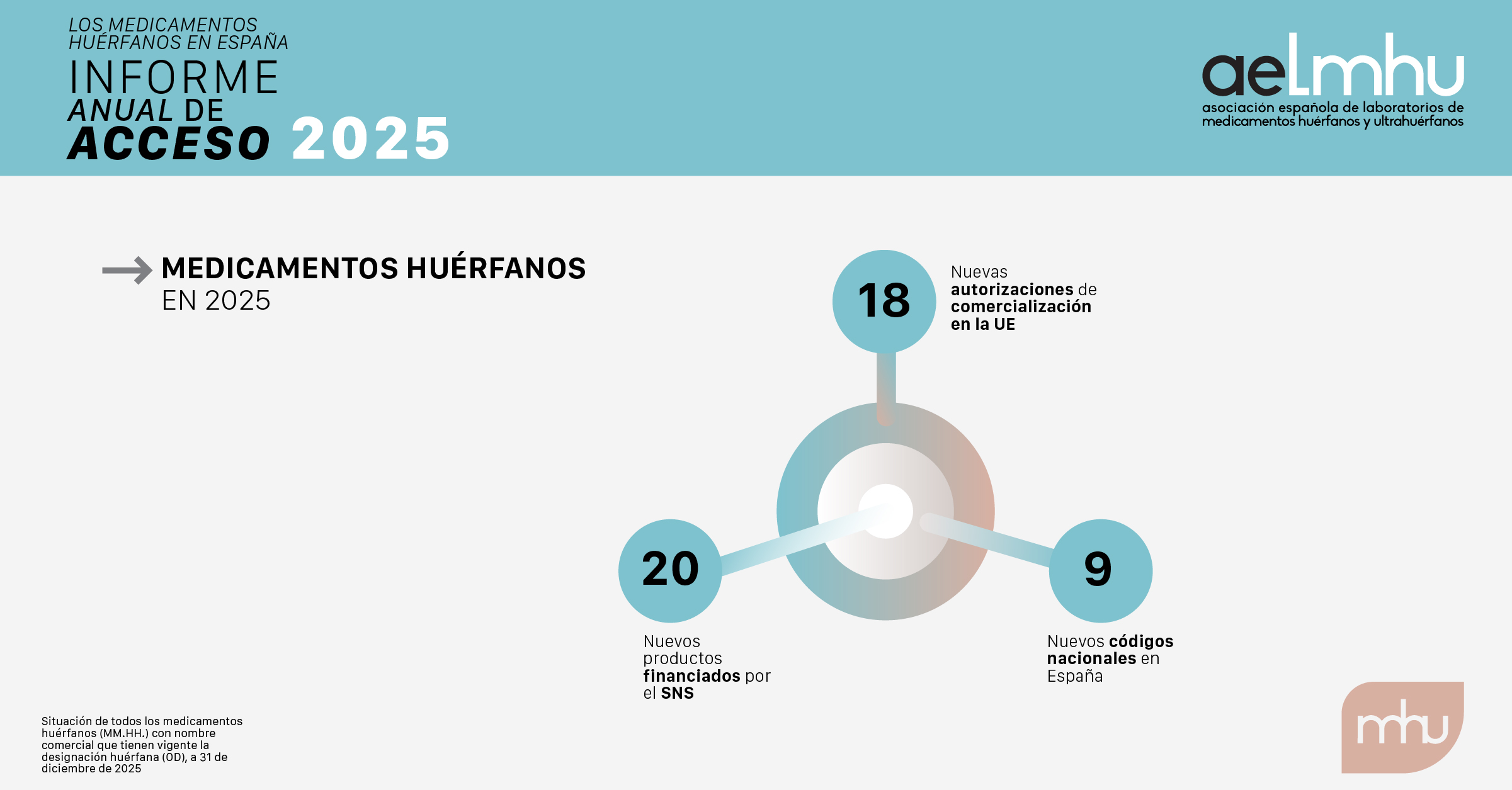
Spain financed a total of 20 orphan drugs (ODs) for rare diseases in 2025, three more than the previous year, according to the results of the Annual Report on Access to Orphan Drugs in Spain 2025, published on Monday by the Spanish Association of Orphan and Ultra-Orphan Drug Laboratories (AELMHU).
The report, which analyzes the situation of these treatments in Europe and their availability to patients in Spain using data from various European and Spanish public sources as of December 31, 2025, tracks the evolution of indicators such as marketing authorizations in the European Union, as well as the obtaining of the National Code (CN) and financing by the National Health System (SNS) in our country.
The data in the report show a positive trend in the financing of orphan drugs in Spain, reflecting the commitment of the pharmaceutical industry and all stakeholders in the sector to people living with rare diseases. However, significant challenges remain in terms of funding, waiting times, and the arrival of innovation in Spain, which is why we believe it is necessary to continue moving toward a system that guarantees more agile, predictable, and uniform access to these drugs for all patients, especially those who have no other therapeutic alternative," says Beatriz Perales, president of AELMHU.
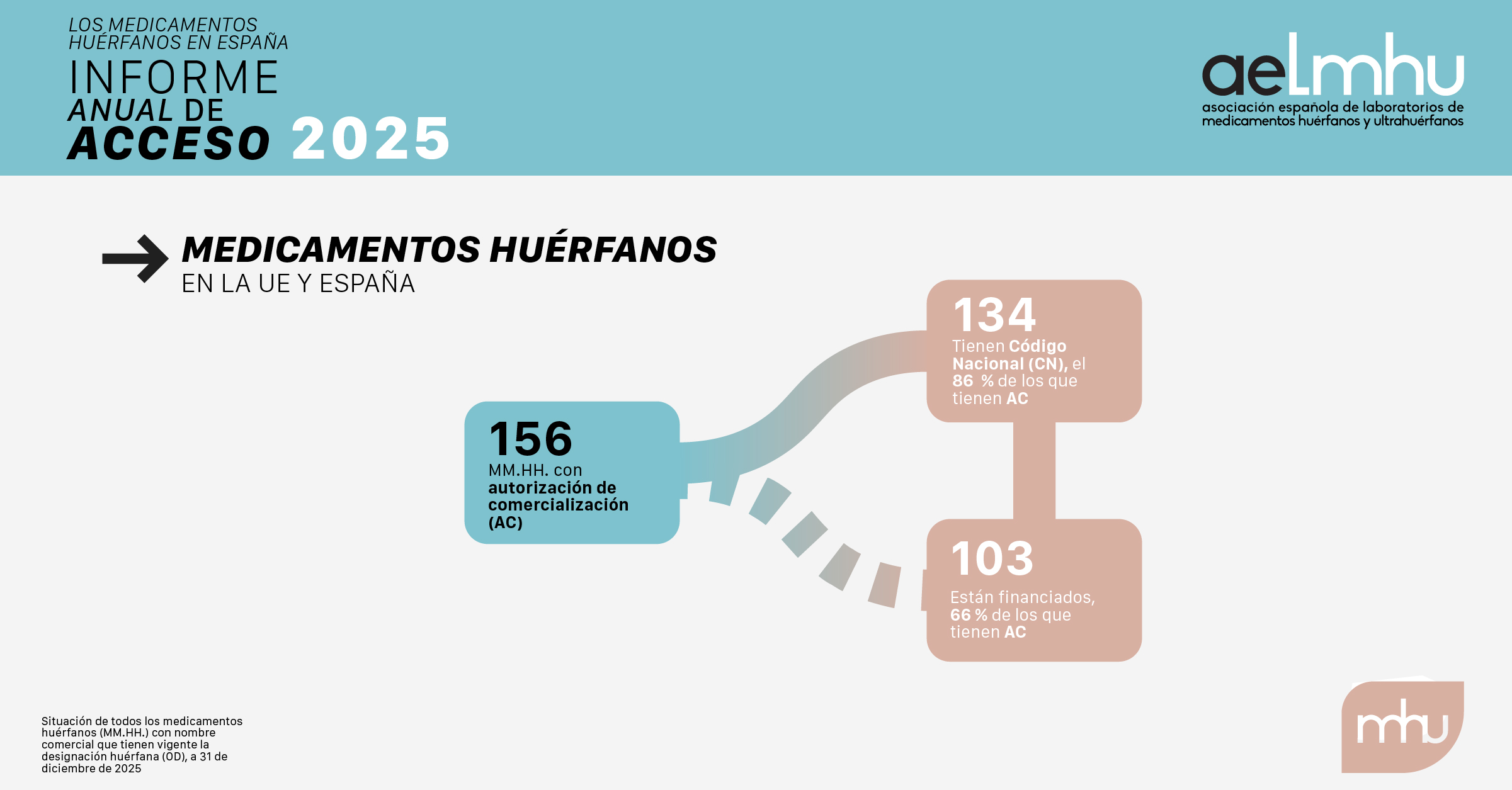
Spain finances 66% of the humanitarian aid authorized in the EU.
The report reveals that the number of orphan drugs funded in Spain last year is the second highest since 2020, surpassed only by the all-time high recorded in 2023 (21). In addition, 58 treatments for rare diseases have been funded in the last three years, compared to 28 that received funding between 2020 and 2022.
Thus, at the end of 2025, the National Health System already finances a total of 103 orphan drugs, 66% of the 156 that are authorized for marketing in the European Union (EU), which is eight percentage points more than the previous year (58%).
At the EU level, 18 drugs obtained marketing authorization from the European Commission in 2025, an improvement on the 17 treatments authorized the previous year.
However, this increase has not been reflected in the new drugs that obtain a National Code in Spain, a necessary step prior to applying for inclusion in public funding. Last year, only nine drugs obtained the NC, 64% less than the 25 registered in 2024.
On the other hand, the report indicates that in Spain there are still 31 orphan drugs with a National Code that are not funded, 15 fewer than in 2024 (46), and that 42% of them have been waiting for a favorable funding decision for more than three years, compared to 39% at the end of 2024.
Human resources wait an average of 23 months to be funded.
In 2025, the average waiting time between an orphan drug obtaining its National Code and the approval of its funding remained at 23 months, the same as in the previous two years.
On the other hand, of the 20 new orphan drugs included in the National Health System during the last year, 25% waited less than a year to obtain funding, 50% between 1 and 2 years, and 25% more than 2 years. One positive development is that the percentage that has waited more than 2 years has fallen slightly compared to 2024, by 4 percentage points.
As for the evaluation process, six of these drugs were funded at the first meeting of the Interministerial Commission on Drug Prices (CIPM). However, another six had to go through at least three meetings of the Commission before obtaining funding, highlighting the need to move towards a more agile and efficient model that helps reduce the time it takes for patients with rare diseases to access therapeutic innovation.
Spain funds two new advanced therapies for rare diseases
The AELMHU Report also covers the evolution of advanced therapies for the treatment of rare diseases. In this context, the funding of two of these therapies in 2025 is particularly noteworthy, a milestone that reaffirms the change in trend that began in 2024, after none were funded in 2022 and 2023. Currently, 15 advanced therapies have marketing authorization in Europe, of which nine are funded by the Spanish National Health System (SNS) and 14 already have a national code in Spain.