19/09/2025
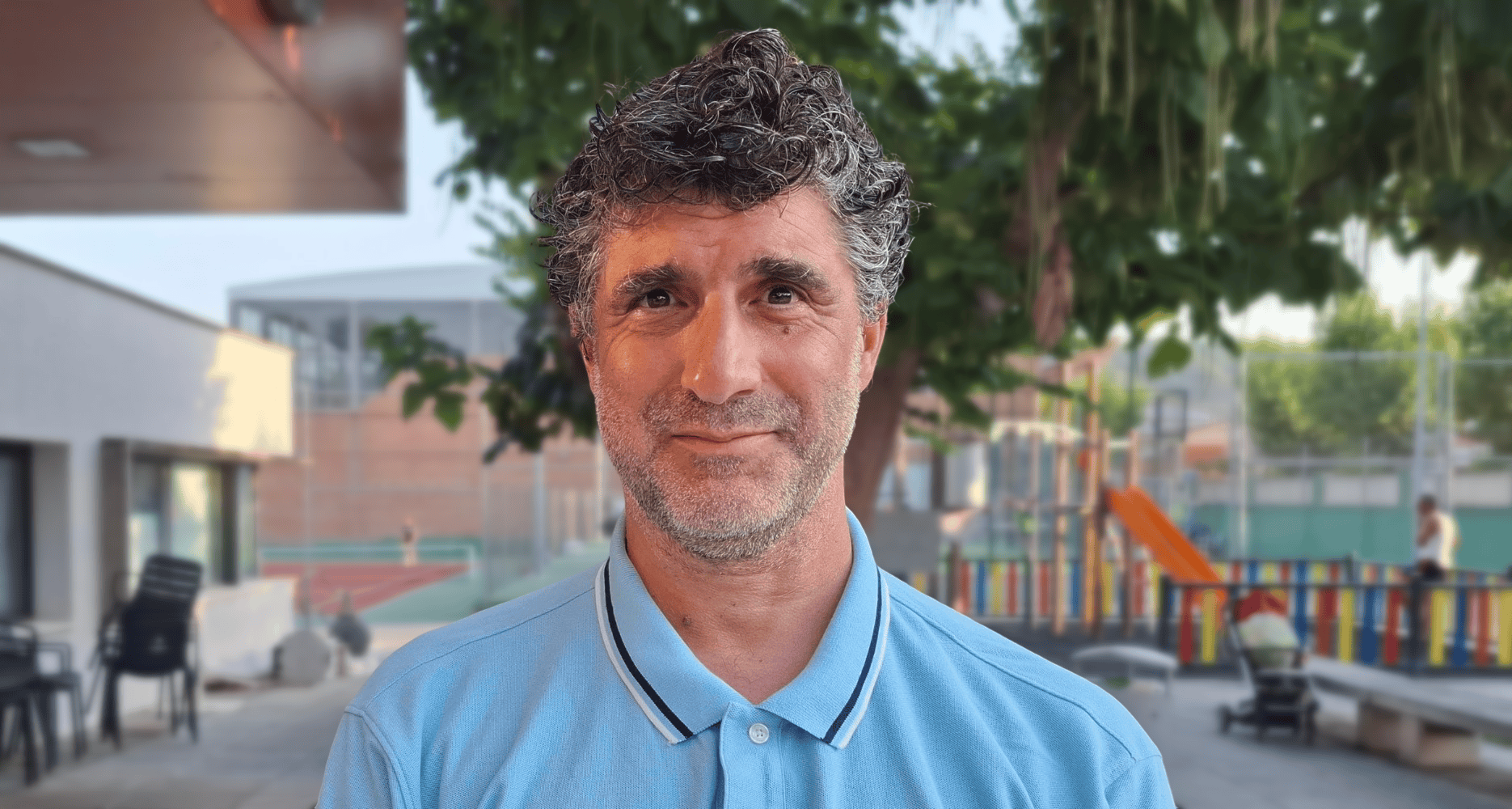
At the age of seven, when he was in the second year of primary school, Guillermo Yriarte (Seville, 1974) began to lose his sight in one eye. Soon after, the other eye also began to fail. It was 1982 and, as was the case with many other rare diseases, knowledge, both in society and among health professionals, was scarce and very limited.
Then the first difficulty began: the diagnosis. No doctor knew exactly what was wrong. The possible explanations varied: from psychological causes to the suspicion of a brain tumor. For a year, his family navigated the uncertainty, between appointments, medical tests and contradictory opinions.
Finally, in Barcelona, an ophthalmologist recognized what others had not seen before: it was an Leber's Hereditary Optic Neuropathy (LHON), a rare mitochondrial disease that causes progressive loss of central vision. The impact of the diagnosis was twofold: on the one hand, it put an end to her uncertainty. On the other hand, it opened a door to an unknown, complex and hitherto invisible reality.
Guillermo was the first case diagnosed in his family. But not the last. Before long, as many as six of his cousins began to experience the same symptoms. Thus, they began to connect the dots and to understand that it was a genetic mutation of mitochondrial origin, transmitted maternally. "This mutation found a favorable situation in a family like mine, since my mother has five sisters and the mitochondrial inheritance comes directly from the mothers," she explains in an interview with AELMHU on the occasion of World Pathology Day, which is celebrated this September 19.
The birth of ASANOL
In the first years after the diagnosis, the Yriarte family thought that their case was unique. Gradually, however, they discovered that there were other similar stories. The pattern repeated itself: families with many sisters, several affected descendants and a long journey to obtain a diagnosis. It was then that the idea was born to create an association that would give a voice to a disease that, in addition to being rare, was deeply unknown.
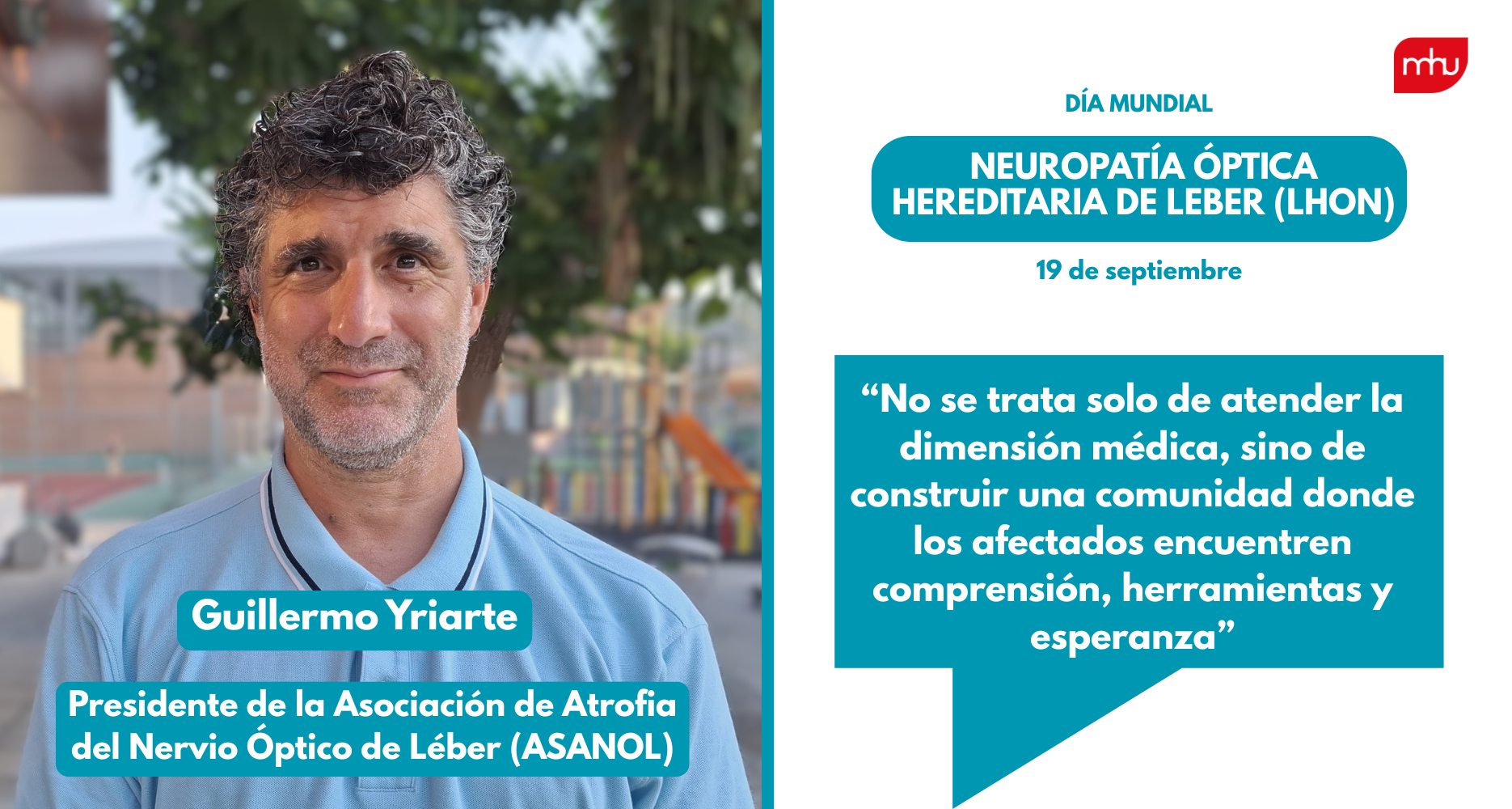
Thus ASANOL (Leber's Optic Nerve Atrophy Association) was created with the aim of making the pathology visible, forming a support network for those affected and promoting scientific knowledge and research. In addition, the association offers training, workshops, legal advice and psychological resources to those affected. " The aim is not only to address the medical dimension, but also to build a community where those affected can find understanding, tools and hope," says the president of the association.
ASANOL currently has between 80 and 100 members. As Guillermo Yiriarte, its president, points out, diagnosing the disease as soon as possible is a key factor in its evolution, since the probability of responding favorably to treatment is greater if it is started early.
According to the latest scientific studies, it is estimated that LHON may affect between 1 in 27,000 to 45,000 people worldwide. This makes it the most common primary mitochondrial disease.
The disease has many faces. Its most common manifestation is the sudden and usually irreversible loss of central vision.. This permanent loss of vision is the result of the death of cells in the optic nerve, which is responsible for transmitting images from the eyes to the brain. But the pathology is not limited to the eyes. In some cases, cardiac, muscular and even neurological complications, such as epilepsy, have been identified.
It mainly affects young men, although it can also occur in women. It most commonly begins between the ages of 16 and 30, in the middle of the academic or professional definition stage. For many patients, this represents a radical change in their life plans.
Life with LHON
Unlike those who lose their vision in adulthood, Guillermo's childhood was marked by learning from visual impairment. Today he retains 5% of his vision, which, far from slowing him down, has been the starting point to build a full and autonomous life.
"From the outside it may not seem like much, but for me it's all I know. I learned how to do things by seeing little, and I have been able to adapt my life, my studies and my profession to that reality. I don't drive, I don't play tennis, but I like to walk the countryside. I always say there are more things I can do than things I can't," he reflects.
This temporal difference between those who lose their vision in childhood and those who lose it in adulthood also marks the way in which they face the disease. " There are people who have had to give up their jobs after diagnosis, while others have been able to redirect their careers toward new job opportunities compatible with low vision," Guillermo points out.
The importance of partnerships
Thus, through the association, Guillermo and many others living with the condition have turned their diagnosis into a starting point. “For those of us living with this condition, the experience we’ve had within the association has been very beneficial. We’ve been able to personally connect with the world’s leading experts on our condition. We’ve shared experiences that have helped us improve our independence and psychological adjustment… We’re confident that our outreach efforts will lead, sooner or later, to an increase in research, ” says Guillermo.
Thanks to their joint work, and the increasing visibility of rare diseases, LHON is gradually becoming a more recognized pathology. "Ten years ago, ophthalmologists hardly knew about this disease," explains the ASANOL president. "Now it is more talked about in universities, congresses and the media. We would like to think that, in part, it is thanks to the work we have done from the association."
Over the years, the association's participation in medical congresses has also enabled professionals to learn firsthand what it is like to live with the disease. These meetings not only enrich researchers, but also greatly help patients. "When a doctor sees how a person with low vision lives, moves, works or raises their children, it changes their perception. And that change drives them to do more and better research," says Guillermo.
"Unity is strength."
In fact, scientific research has advanced significantly in recent years. In the field of mitochondrial diseases, where LHON is included, advanced therapies are opening horizons that previously seemed unattainable.
But there is a structural problem: the number of patients. As with many rare diseases, the scarcity of clinical cases makes it difficult to conduct trials with a sufficient statistical basis. That is why one of ASANOL's most important missions is to locate affected individuals and put them in contact with researchers.
In this regard, Guillermo stresses the importance of learning from the good practices of other countries, such as Sweden or Denmark, where "the approach to rare diseases is much closer and more personalized". "In these countries, once a rare disease is detected, you are assigned an expert who is aware of your disease and your needs. They let you know what treatment possibilities you have or what research is being done, etc.," he explains.
The president of ASANOL also emphasizes the importance of collaboration among those affected, both locally, nationally and even internationally. "Unity is strength, and even more so in our case. If each national association connects with others at the European and global level, we can multiply the number of people willing to collaborate in research. I think this is the only way forward," concludes Guillermo Yriarte.