
13/10/2025
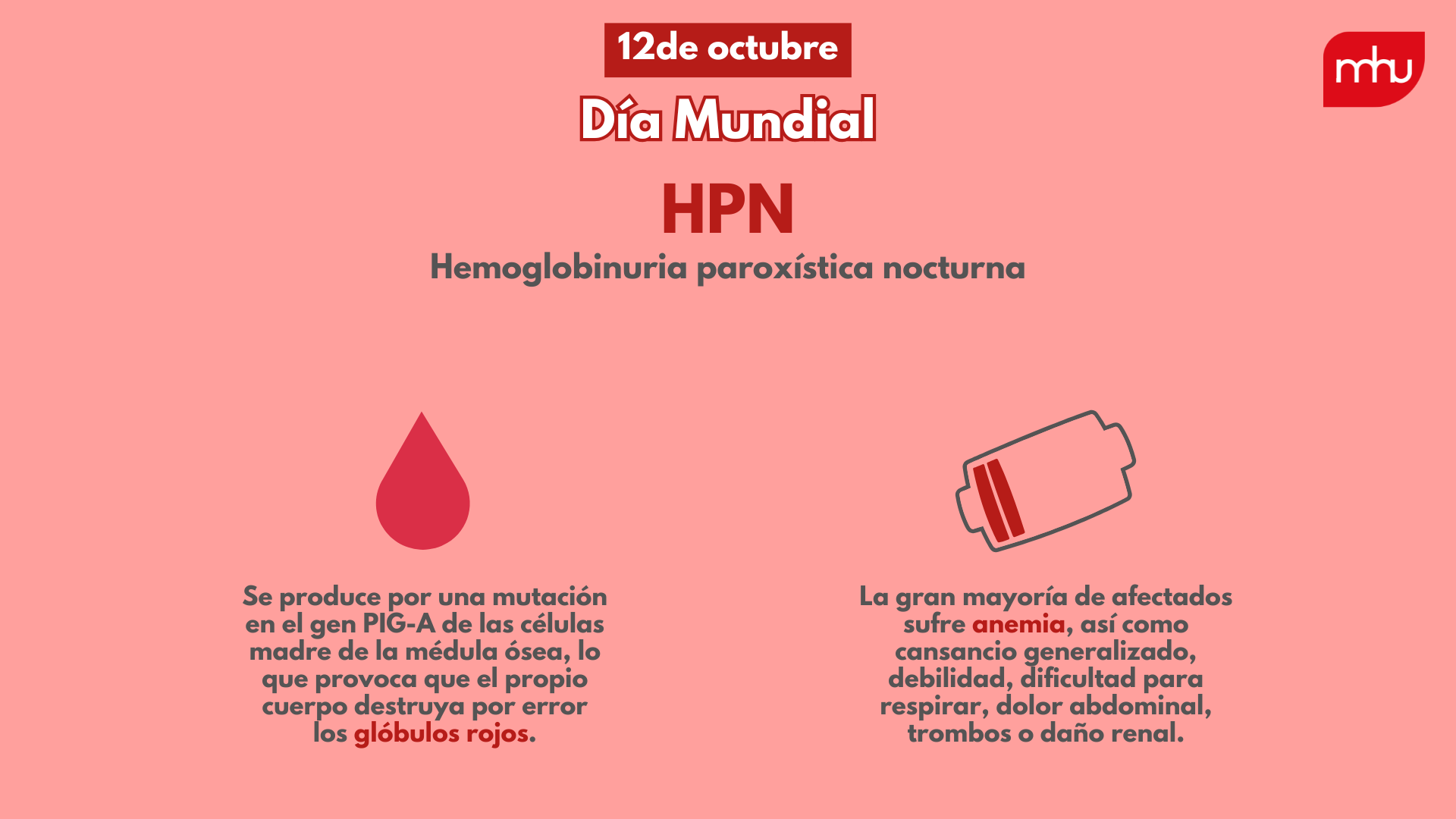
October 12 marks the International Day of Paroxysmal Nocturnal Hemoglobinuria (PNH), a hematological disease that affects only 1 to 1.5 persons per million inhabitants worldwide, and is therefore considered an ultra-rare pathology.
PNH is an acquired pathology, i.e. it is not born with it and cannot be inherited. It is caused by a mutation in the PIG-A gene of bone marrow stem cells, which causes the body to destroy red blood cells by mistake. Due to the hemoglobin that is released when they are eliminated, one of the characteristic manifestations of the disease is reddish-brown urine.
However, it is not the most common symptom. The vast majority of people with PNH suffer from anemia, as well as generalized fatigue, weakness, shortness of breath, abdominal pain, thrombi or kidney damage. This clinical picture makes it difficult for many patients to carry out many of their daily activities normally, which can affect their work performance and have a major social and emotional impact.
To delve deeper into the challenges of living with this pathology, we interviewed Adriana Reyes, president of the HPN Spain AssociationShe tells us about her diagnosis, her story of personal overcoming, her struggle to accept the consequences of the disease and how she has come to live as normal a life as possible.
A childhood in the hospital
Adriana's life began to change when she was just nine years old. She was wrongly diagnosed with spinal aplasia, and spent much of her childhood in hospitals in her home country of Ecuador. "At that time, very little was said about the feelings of patients, and even less about the younger ones. For me, being constantly in hospitals had a great emotional and also social impact, because I hardly interacted with other children. I lived as if in a bubble, I was like a 'glass child'," she recalls.
As time went by, already in her teenage years, she began to suffer from new symptoms more typical of PNH, such as episodes of dark urine. However, the confusion with her disease continued for some years. Adriana describes this period as one of "absolute uncertainty": "My family ran out of money.My family ran out of money and resources, looking for ways to take me to private doctors to see what was wrong with me," she says .
Finally, the definitive diagnosis came during one of those visits to a nephrologist. There he heard for the first time the name of his real disease: paroxysmal nocturnal hemoglobinuria. Along with the diagnosis also came another key moment: his move from Pediatrics to Hematology to fight the disease. That moment marked a before and after for Adriana: "On the one hand, I finally gave a name to the disease that had been deteriorating my life and that of my family for so many years. On the other hand, it meant leaving the pediatric environment in which I had felt so protected.
After the diagnosis, came the tests, the analyses and the search for possible solutions. "I remember my parents crying because they had been told that I had only a few months to live. They began to carry out charitable actions so that I could at least receive blood transfusions and decent care. Seeing this suffering of my whole family, I even wondered if it was worth it to keep fighting," Adriana recalls.
Emigration to Spain
In 2003, her mother, like many other Ecuadorian compatriots, made the difficult decision to emigrate from her country to offer her daughter a chance to overcome her illness. With the help of an aunt who was already living in Spain, they managed to reach our country. But it was not a bed of roses: "It was hard to adapt to a new country, with the loneliness of having left my family and the difficulty of integrating".
Moreover, although he already had a confirmed diagnosis from Ecuador, in Spain he had to go through the whole process again. "I had to repeat over and over again my symptoms and many doctors did not know what PNH was. I didn't understand how in this first world, where I was supposed to find healing, many doctors didn't know about the disease," she laments.
His luck began to change when he was offered to participate in the first clinical trial of a drug for PNH. "Although I didn't fully understand what it meant to participate in a trial, I accepted without hesitation. I had nothing to lose, and soon my symptoms began to improve," Adriana details.
Mother and patient
After two years, however, she became pregnant and the doctors recommended that she terminate the pregnancy or the treatment: "I decided to become a mother. It was a longing I had all my life. I wanted to have that will of my own, after so many things that life had put me through without the ability to decide."
Thus his first daughter, Aisha, was born, and psychologically it began to affect him to think that the disease could leave him without enjoying his daughter. "I always questioned my life, whether it was worth continuing to fight and live. I didn't have a clear purpose, but with my daughters everything changed. Who is going to want their daughters to be without their mother?" she wonders. That emotional state led her to seek support, and she found it in the recently created HPN Spain Association, where she found a space to share her experience and access the psychological help she needed.
Eventually, Adriana became a mother again and again participated in clinical trials, but had to abandon them to travel to Ecuador due to a serious family situation. She then again faced another of the major drawbacks of her illness, job instability.
"I have always had precarious jobs, such as cleaning or caring for the elderly, something that for me is very satisfying for the fact of giving a service to a person who needs it. But for their relatives there was always the doubt of how a person with a disease like mine could take care of someone. And, in the end, they always end up firing me. Another factor has been the constant visits to the hospital for treatment, with the lack of empathy from some bosses," Adriana points out.
The importance of the Association
In Ecuador, he was unable to take the medication, so his disease became destabilized. Back in Spain, his doctors managed to get him to receive the medication outside the experimental setting, a decisive moment in the course of his illness. He also took refuge more and more in the Association: "I had belonged for many years, but always in the background, attending as an audience to the talks or conferences they organized. But I felt the need to help more and I didn't know how".
Today, Adriana is the mother of two healthy girls, ages 17 and 7. Looking back, she recognizes that PNH has taught her to see life differently. She has put that personal learning at the service of other patients through the Association she now presides. There, Adriana has become a key voice for those who are being diagnosed for the first time, helping them cope with the impact and promoting public awareness of a rare and little-known disease.
Since its constitution, the number of people who have joined the Association has been growing year by year, giving more and more visibility to the people who live their daily lives with this disease. In addition to offering individual support, the Association is also, as it was for Adriana, a meeting point to share experiences with people who are living the same situation and build a network of solidarity.
In addition, they complement this advisory and support work with the promotion of scientific research; the organization of seminars and conferences to disseminate the disease among society, patients and professionals; or the promotion of scientific grants that contribute to a better understanding and progress in the search for solutions for PNH.
"Thanks to my life experience and to the Association, I have become a brave and fighting woman, with a great desire to live. I love to tell my experience, to talk to new patients who join and to be able to reassure them in that moment of impact..... Now, I can be that voice as a patient, promoting public awareness of this disease. I have realized that I want to continue helping, training and advancing in the associative world," Adriana concludes.