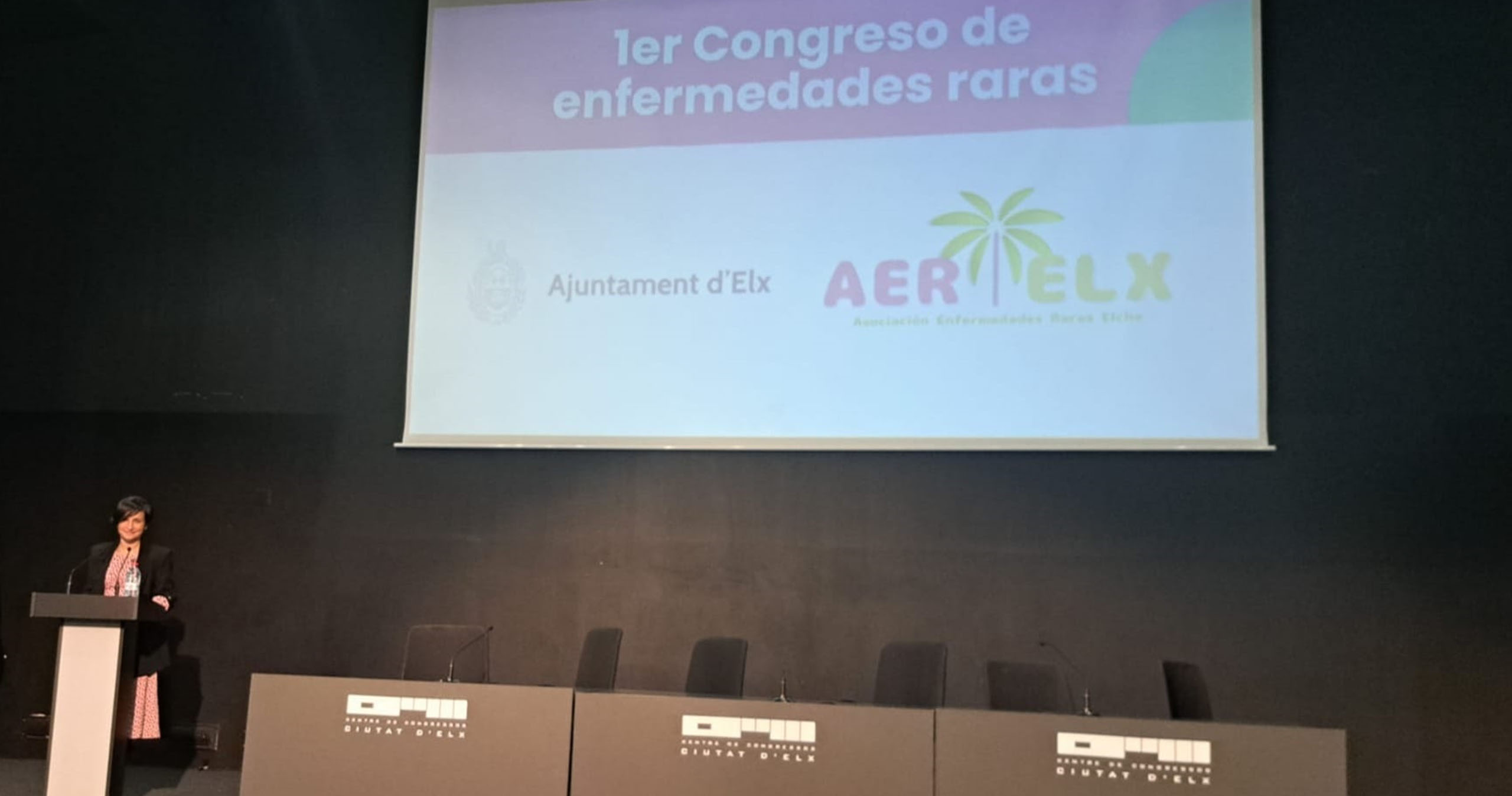
Durante el 13 y 14 de diciembre se ha celebrado el II Congreso Internacional de Enfermedades Raras, organizado por la Asociación de Enfermedades Raras de Elche. AELMHU ha participado en este Congreso, que ha tenido lugar en el Auditorio Centro de Congresos “Ciutat d’Elx”y cuyo objetivo es el de debatir y formar a la comunidad sanitaria y educativa.
On behalf of AELMHU, its director Marian Corral, wanted to shed light and explain the most relevant data from the latest Report on Clinical Trials for Rare Diseases, which highlights that in Spain one out of every four authorized trials is already destined to investigate a rare disease, 2 points more than just a year ago. This growth in research represents a great opportunity that should stimulate the sum of efforts of all the agents involved to place us at the forefront in terms of efficiency, response capacity and attractiveness as a country and thus ensure that more trials continue to arrive and at earlier stages.
However, one of the negative data that we can extract from this report is the waiting time: the average time from when a product obtains the CN until it is incorporated into the SN remains at 26 months, a figure identical to the first four-month period as in the second four-month period of 2023.
Faced with this situation, and with the firm conviction that we must find solutions based on dialogue, commitment and the involvement of all the parties involved. A change of process that allows for greater clarity and predictability in the process and permits early access to treatment for patients without forgetting the sustainability of the NHS. To this end, the association has made a series of proposals, which have been updated and presented to the Ministry in the first half of 2023. These proposals have focused both on an early access model and on the evaluation and financing of orphan drugs. These recommendations have again been included in the contribution that AELMHU has made to the public consultation on the Royal Decree on Health Technology Assessment with the aim of developing, jointly and by consensus, an innovation assessment model specifically for orphan drugs.
In the other presentations, we heard speeches aimed at training teachers and healthcare professionals in order to achieve a more inclusive and just society. Under the slogan 'Together We Will Add', the aim is to improve social empathy through knowledge and information, as well as to help those families whose children are diagnosed with a rare disease, both in the bureaucratic or medical processes and by facilitating day-to-day life.
En palabras de la Asociación, el objetivo es “poner de manifiesto patologías que se tardan mucho en diagnosticar y que, en muchos casos, no disponen de un tratamiento adecuado, así como favorecer la integración en los centros docentes de las personas que las padecen. Siendo por ello vital y de una gran importancia la sensibilización y humanización para ayudar en el día a día de estas familias afectadas”.